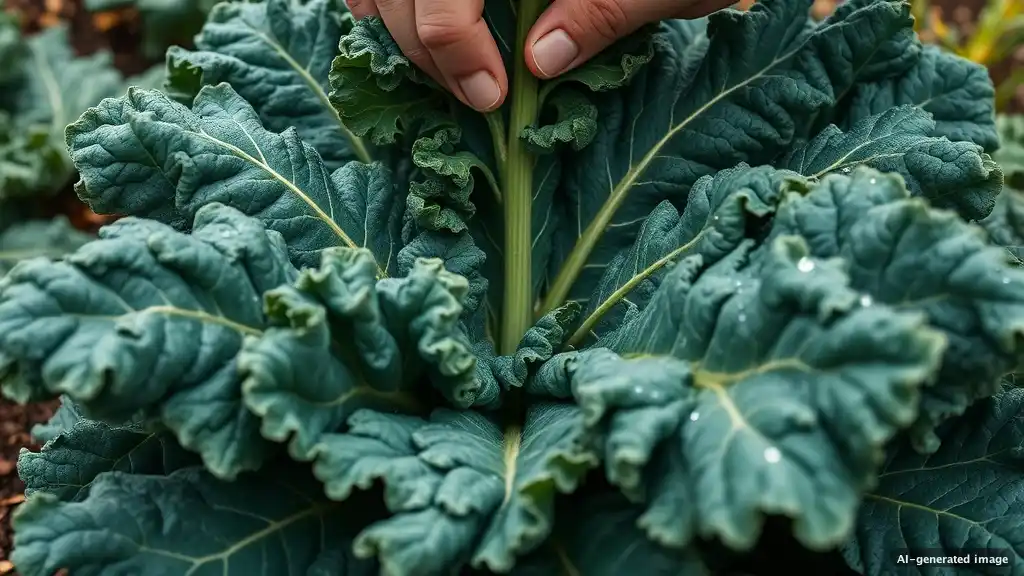
You don't have to wait for the first frost to enjoy sweet kale.
Sellerina4 min readUpdated on October 12, 2026
Thomas and Sellerina · Completed by the community
In short
As the nights get cold from October onwards, kale accumulates sugar in its leaves and tastes milder. If you harvest at low temperatures without actual frost, you will have mild leaves instead of bitter ones until February.
Mild kale without frost
Your kale doesn't need a frost night to become mild.
If you harvest from October onwards, as soon as the nights are cold, you will have mild leaves instead of bitter ones until February. The sweetness lies in the sugar that accumulates in its leaves, which is brought by the cold, which arrives much earlier than the first frost. Kale tastes milder and less bitter as soon as sugar accumulates in its leaves. This happens even at low temperatures, without any actual frost.
If you still wait for the first frost night, you leave ready leaves outside for weeks during a mild autumn like a set table where no one takes a seat. The reason lies in the metabolism, i.e., what the plant does with its sugar. In the cold, it runs on low power and consumes less sugar, while continuing to form sugar in the leaves with sunlight. It's like an account that continues to receive deposits while all standing orders are paused. The surplus remains in the leaves, and the longer the kale matures, the more sugar accumulates there.
Therefore, harvest from October onwards, as soon as the nights have become cold, and take the leaves from bottom to top. The plant remains intact and provides you with the next harvest until February. Frost affects it about as much as a cupboard in the cellar.
By the way, the cold does not bring more vitamins; it only increases the sugar, while the vitamins remain the same. So the kale becomes sweeter, but not healthier, because the cold works in the confectionery and not in the pharmacy. How cold the nights are currently becoming in your location can be shown to you by the free weather forecast for your place at GrowSimply.
The mechanism of sugar formation
Cold transforms kale from a bitter leaf into a sweet treat. When temperatures drop, the plant changes its metabolism and produces more sugar than it can absorb for its own processes. Since this excess sugar is no longer transported to the roots, it accumulates in the leaves instead.
You experience a pleasant sweetness when this accumulation simultaneously reduces the production of bitter substances. If you harvest between late May and August, the kale often still tastes bitter because the warmth slows down sugar production. Light frost can accelerate this process, while continuously cool conditions are ideal for flavor development. Modern varieties also develop their full aroma without the frosty shock.
The right harvesting method
The best way to harvest kale is step by step, so that your vegetables continuously produce new leaves over many months. If you don't clear the plant completely with a single cut but only remove individual leaves, the heart of the plant remains protected and it simply continues to grow. You start at the bottom with the oldest leaves and work from the outside in as well as from the bottom up. If you cut the leaves about the size of a palm, you will get a juicy texture. Cut the leaves very close to the stem so that the stalk or roots do not suffer injuries. If you leave the terminal bud at the top, you prevent the plant's Growing from simply stopping.
Ideally, harvest in frost-free weather, because if kale is frozen, it tends to rot and is easily damaged when moved. If you remove about a handful of leaves per week, you prevent excessive Growing that could make the leaves taste bitter. You can start your harvest as early as mid or late October, with the main season falling between November and February. In Germany, regional produce is often available from November to March. If you wait until after the first frost, kale will give you a particularly mild and sweet aroma.
Shelf life and preservation
The choice of your method determines how long your kale stays fresh. If you store it in the vegetable drawer of your refrigerator with high humidity, it will last about 6 to 7 days, reaching its maximum freshness within two days. In a plastic bag in the coldest part of the fridge, it remains edible for only about 3 to 5 days. If you keep it in an unheated cellar or a pantry at temperatures below 8 degrees Celsius, its freshness will already be at its end after two days.
You prevent rot and extend the time if you wash the kale thoroughly of any soil and sand residue before storing it, but do not cut it or store it wet, as moisture and damage shorten shelf life. If you blanch the leaves in boiling salt water for 2 to 5 minutes beforehand and then shock them in ice water, you can freeze them in the freezer at a constant -18 °C for about 9 to 12 months. If you preserve it in jars with salt water and store it cool and dark, you can keep it for about a year. You get crispy chips if you dry the marinated leaves at 40 to 50 °C for six to eight hours or use fermenting in brine as an alternative. If your conservatory needs protection from snow and winter weather, a greenhouse or plastic film covers will help your harvest.
Videos open in a new tab at the respective provider. Their privacy policy applies there.
Contributions from garden friends
Have you had your own experiences with this? Add them — together we make this article better.
You have not set a nickname yet. You can set it in your account.
Do you know about this? Log in to add your knowledge here.
0 / 1500
Review and submit contribution
We read every contribution before it goes public — this sometimes takes a day. After that, it is visible to everyone with your nickname above it.
Report contribution
Please describe in detail what is wrong with this contribution.
Thanks! Your contribution is now under review. As soon as it's approved, you'll receive an email.
Thanks, we'll look into it.
No mental checklists needed — GrowSimply puts the right steps on your to-do list at the right time.
The Vegetable Guide is free — the sowing calendar and the recipes are free to use with an account, too. Behind GrowSimply are many years of development and high running costs. But we deliberately do without advertising. There is no tracking either. If the project helps you, support it now — so it stays this way.
The guide explains the craft. With GrowSimply you can apply it. You get a personal growing plan with suitable time windows for your location (with postcode-accurate weather data), can implement sustainable planning by following crop rotations, and even receive recommendations for good neighbours. So you don't forget anything, you always get to-dos at the right time. GrowSimply wants to be the only app you need – without ads and tracking.
 Sellerina