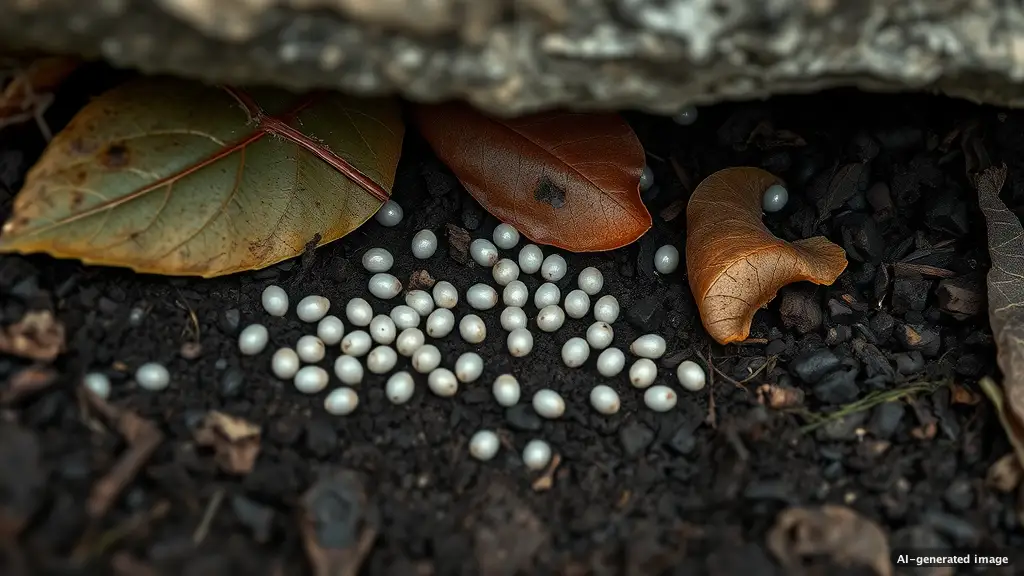
You defeat the next generation of slugs by exposing their eggs to the sun or frost.
Thomas4 min readUpdated on October 19, 2026
Written by Thomas, GrowSimply developer who loves good food.
In short
If you lift paving stones and containers in late autumn and expose the tiny eggs, you prevent a plague in spring. The eggs dry out in the sun or are eaten by birds, so that snails visit your lettuce much less frequently in May.
Fewer slugs in spring
In autumn, you will now find snail eggs and thus prevent a plague. In the garden, these tiny, whitish spheres, as small as pinheads, are often found together in a cluster called a clutch.
If you find such a clutch, it means up to four hundred fewer snails in your garden in spring. The eggs overwinter well hidden in the soil and then crawl out in massive numbers in May, exactly when your first young plants are outside. It hardly gets any more punctual than that.
The eggs seek out a moist and protected place, such as in the compost, under paving slabs, containers or just below the surface of the earth. If they lie exposed, however, they dry out in the sun, freeze or are eaten by birds like blackbirds and thrushes. These are three helpers that do the job for you, none of whom will send a bill. For a blackbird, an exposed clutch is not a garden problem, but a set table.
You simply lift boards, paving slabs and containers now and look underneath them. You then just leave the small white spheres exposed. When the first frosts arrive, it is worth your while to loosen the soil deeply again in these places so that even buried clutches come to light. You don't even have to destroy the eggs; exposing them is quite enough.
If you proceed like this, snails will visit your lettuce much less frequently in May, without any poison at all. They were never on the guest list for your lettuce anyway.
Typical locations
You will find snail clutches where it is nice and cozy for them. If you look specifically for damp and shady hiding places, you will discover the egg-laying sites much faster. The eggs are often found under paving slabs, flat stones or in soil cracks and cavities. You can also find them between paving stones, under loose stones at the edge of the flowerbed or in piles of leaves, deadwood and compost heaps.
When you examine planters, buckets, troughs or rain barrels, you will often expose them as popular locations for a warm and moist microclimate. The clutches can even slumber directly in the damp soil under the pots or in their cracks. When you look at mulch layers, you will also frequently find hiding places there. In flowerbeds, small holes or depressions with a depth of about 2 to 10 centimeters often form. Since snails themselves cannot dig, they use crevices up to a depth of 20 centimeters as a hiding place. Wilted cabbage leaves, Tagetes or half-rotted zucchini remains act like magnets for the animals and lure them to lay eggs.
The ideal period
The ideal period for hunting slug eggs ranges from late summer to the first frost. If you start searching as early as late autumn, you prevent a small clutch from becoming an entire army. The Spanish Slug lays its eggs starting in June, with egg-laying peaking between August and September. If the weather remains mild, this process can extend into December.
You will save yourself a lot of work during later control if you search specifically for clutches in October, as this month is a focus for egg-laying and removal. The Great Grey Slug starts its egg-laying in September, as soon as the days get shorter and the soil is still warm. If you use sacrificial zones, you must check them every two days so that you don't miss any clutches. You will find the eggs best on damp days or immediately after a rain shower. As soon as the nights become noticeably cooler, you can end your search, because the first frost brings a natural end to the slugs.
The next generation
You defeat the next generation of slugs by deliberately exposing their egg clutches to sun or frost. If you break up the top layer of soil about 5 to 10 cm deep with a garden fork or a hoe, the protective earth holes will be opened and the eggs brought to the surface. Ideally, you should do this step exactly one day before a change in weather followed by dry sun or light night frosts. If you collect the clutches with clumps of soil and place them directly on stones or walls, you will massively accelerate the drying process. The eggs turn into harmless dust within a few hours due to direct sunlight and UV radiation, preventing any offspring from hatching.
If you then level the growing area evenly with the back of a rake, you prevent new depressions for future egg-laying. However, you must be careful, as water will not help you in the fight, since slug eggs can survive in water for a long time due to their slime. Frost is also not an automatic savior, because special proteins act like a biological antifreeze to protect the eggs from freezing and a layer of snow acts as insulation. In particularly hard-hit problem areas, tilling in late autumn is therefore a conscious exception to the usual soil conservation.
Natural enemies
Natural enemies turn your snail eggs into a free meal for the garden. If you expose the eggs from the soil, you offer blackbirds, thrushes or starlings a buffet. You save yourself expensive pesticides if you use the clutch as a food source. If the sun does not dry out the eggs quickly enough, it helps to dig them up and simply place them on the surface.
Then they land directly on the menu of hedgehogs or birds like the blackbird. You create natural control when you open the soil for animals such as shrews, moles, magpies, great spotted woodpeckers, redstarts, gulls, frogs, toads, newts or slow worms. Even other snail species such as the tiger snail or the Roman snail eat the eggs of other species. Your garden thus becomes a small canteen for everything you actually do not want in your vegetable patch.
When loading, YouTube (Google) transfers data such as your IP address and may store information on your device.
Privacy policy
No mental checklists needed — GrowSimply puts the right steps on your to-do list at the right time.
The Vegetable Guide is free — the sowing calendar and the recipes are free to use with an account, too. Behind GrowSimply are many years of development and high running costs. But we deliberately do without advertising. There is no tracking either. If the project helps you, support it now — so it stays this way.
The guide explains the craft. With GrowSimply you can apply it. You get a personal growing plan with suitable time windows for your location (with postcode-accurate weather data), can implement sustainable planning by following crop rotations, and even receive recommendations for good neighbours. So you don't forget anything, you always get to-dos at the right time. GrowSimply wants to be the only app you need – without ads and tracking.
 Thomas