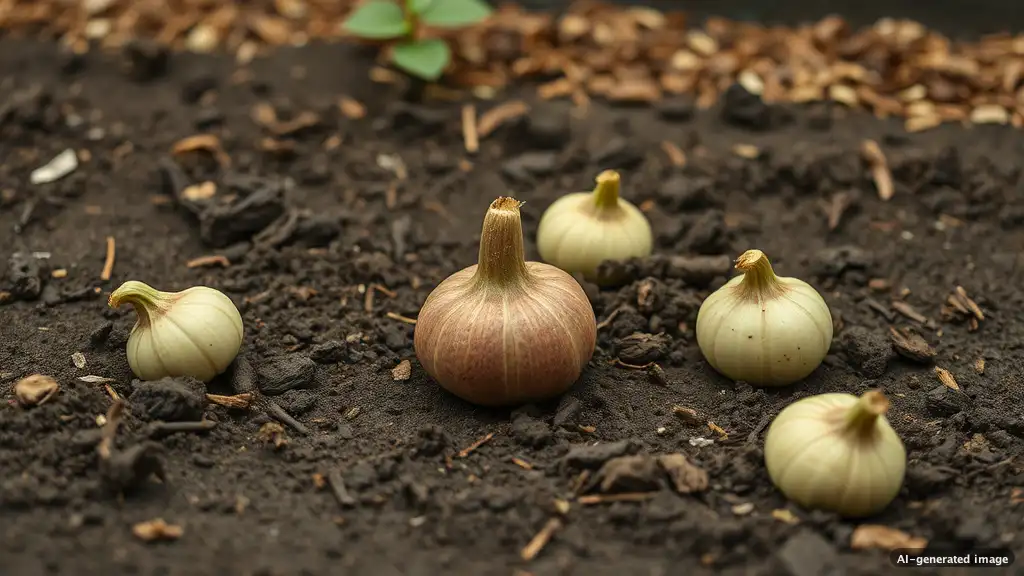
To ensure you find beautiful cloves instead of single round bulbs when harvesting, your garlic needs a cold stimulus.
Sellerina3 min readUpdated on September 29, 2026
Thomas and Sellerina · Completed by the community
In short
Only if the garlic undergoes a frost period will the bulb split into individual cloves in July. If you missed autumn, you can simulate the necessary cold stimulus for six weeks in your refrigerator's vegetable drawer at five degrees.
Clean cloves when harvesting
If you plant your garlic in the ground in autumn, the bulb will split into clean, individual cloves on its own in July. If instead you plant it as early as spring, you will mostly harvest only a single round bulb in July. This is sometimes intentional. If you would rather harvest individual cloves, I'll tell you here how to do that. The garlic simply lacks the cold stimulus in spring soil, which is called vernalization. Without this frost treatment, the plant will dutifully produce its foliage and grow, but it won't split. If this cold stimulus is missing, the clove remains in your hand as a single round object instead of splitting up.
You need four to eight weeks under ten degrees Celsius in the soil for winter garlic to trigger the division. Only after this cold stimulus does the plant form several cloves around the stem in spring. If these weeks are missing, the garlic simply continues to grow as a single large bulb. I call that an excuse by the plant; it simply never got its frost treatment.
Now take a firm bulb without rotten spots from your own harvest and break it into individual cloves. The tip must point upwards during this process. You plant each clove three to five centimeters deep in loose, humus-rich soil. If you leave ten centimeters of space to the next clove in the row and twenty centimeters between rows, everything will have its place. Make sure that no waterlogging occurs, because garlic does not tolerate that.
Spread a thin layer of mulch over the soil before the first frost arrives. If you missed autumn, your refrigerator will help you. Otherwise, it only keeps yogurt cold, but six weeks in the vegetable drawer at five degrees replaces the necessary cold stimulus. After that, you can plant your cloves in the bed in February or March.
Set a cold stimulus in the refrigerator
Your refrigerator compartment can simulate winter for your garlic so that it is ready for planting. If you use the vegetable drawer as a substitute for the cold period, you are applying a targeted stimulus to the plant. Set the compartment as low as possible without the garlic freezing. Since temperatures below 10 °C activate the germination hormone gibberellin, sprouting already begins at these values. An exact duration for this cold stimulus is not known, but the garlic needs this time in the cold to understand its growth phase.
Avoid storage risks
Moisture is the greatest enemy of your garlic stores. If you store insufficiently dried, so-called "wet garlic", the water feeds pathogens, leading to soft spots and the decay of the bulbs. You lose your harvest to rot if you keep the garlic in plastic containers, as condensation forms there, which promotes mold growth. Even invisible bruises can manifest as mold later on, which is why you should only select healthy cloves without injuries or signs of rot before planting. You save yourself trouble and secure your harvest if you divide the bulbs about a week before sowing.
Optimal planting techniques and protection
You secure your yield when you plant the garlic cloves carefully in the soil. If you plant them in September or October, you will harvest large cloves, while March is the best time for spring sowing. You prevent root rot if you place the cloves in loose, nutrient-rich substrate and ensure that the tip points upwards. If you maintain a distance of at least 10 cm between individual cloves and place them at a depth of about 2.5 to 5 cm, water can run past the root instead of stagnating there. You protect your plants from freezing and drought if you apply a mulch layer, e.g., made of straw or coarsely chopped leaves, over the garlic. If you mix the leaves with grass clippings, the fibrous grass material forms a cushion against heavy ice or snow loads. You save valuable nutrients in the soil because the mulch protects them from leaching and simultaneously protects your plants like a buffer against strong winds. If you pay attention to a high humus content and use sandy or deep loam soils, the garlic will find the ideal place for its Growing.
Videos open in a new tab at the respective provider. Their privacy policy applies there.
Contributions from garden friends
Have you had your own experiences with this? Add them — together we make this article better.
You have not set a nickname yet. You can set it in your account.
Do you know about this? Log in to add your knowledge here.
0 / 1500
Review and submit contribution
We read every contribution before it goes public — this sometimes takes a day. After that, it is visible to everyone with your nickname above it.
Report contribution
Please describe in detail what is wrong with this contribution.
Thanks! Your contribution is now under review. As soon as it's approved, you'll receive an email.
Thanks, we'll look into it.
No mental checklists needed — GrowSimply puts the right steps on your to-do list at the right time.
The Vegetable Guide is free — the sowing calendar and the recipes are free to use with an account, too. Behind GrowSimply are many years of development and high running costs. But we deliberately do without advertising. There is no tracking either. If the project helps you, support it now — so it stays this way.
The guide explains the craft. With GrowSimply you can apply it. You get a personal growing plan with suitable time windows for your location (with postcode-accurate weather data), can implement sustainable planning by following crop rotations, and even receive recommendations for good neighbours. So you don't forget anything, you always get to-dos at the right time. GrowSimply wants to be the only app you need – without ads and tracking.
 Sellerina