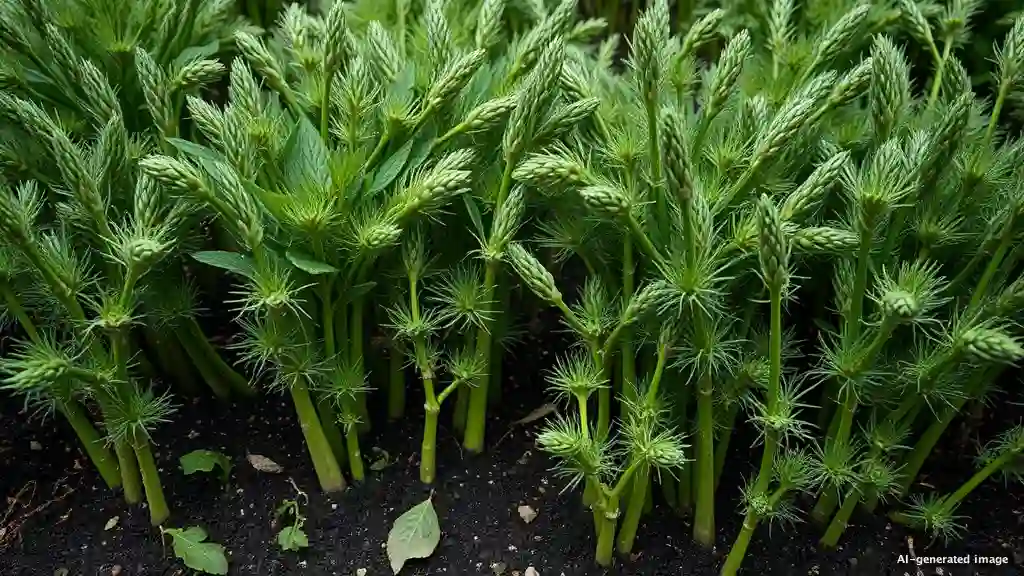
Anyone who cuts the greens too early takes away the plants' strength for next year.
Sellerina4 min readUpdated on September 20, 2026
Thomas and Sellerina · Completed by the community
In short
Leave your asparagus foliage standing after St. John's Day on June 24th so it can store energy as carbohydrates in the rootstock. The leaves serve as a photosynthesis factory and are essential for building up reserves for the next growing season.
Harvest stop and regeneration
Once you finish your harvest, leave your asparagus alone so it can recharge. Traditionally the growing season ends on June 24th (St. John's Day), and those who observe this date give the plants the necessary time to regenerate. From that point onwards, the fine, feathery green shoots serve as a "photosynthesis factory," collecting energy and storing it in the rootstock in the form of carbohydrates. This phase is important for building up reserves for the next harvest year. If you allow the plant this regeneration time, it can be harvested repeatedly for decades. In the first two years, you should only harvest a small amount over a period of two weeks. In the third year, you can extend the harvest period by one week per growing season, harvesting for three weeks, and in the fourth year expand to four weeks. End the harvest time at the latest when the spears become significantly thinner. The asparagus foliage must not be cut after harvest, as it is essential for directing energy into the roots in the form of carbohydrates.
Asparagus fern care
When you walk over your garden bed in summer, you see the foliage standing before you like a factory of green leaves. These plants use sunlight to produce carbohydrates and direct them straight into the rhizome. The foliage absorbs nutrients during the long growing season that are important for building up reserves. You should not cut back the foliage prematurely in summer, as you would interrupt the energy transfer to the rhizome and thus reduce next year's yields. Pruning is only necessary if stems are actively affected by diseases such as asparagus rust or rot. Thinner shoots can be left standing in summer; they grow into stronger fern plants. If the tall perennials in your garden beds might fall apart or break, a taut string helps as support. The remaining shoots can reach up to 1.50 meters high and even two meters in summer while forming flowers. Female plants develop red berries through pollination that can cause stomach aches — caution is therefore advised during harvest. Since berry development costs a lot of energy, male plants are mostly preferred for cultivation.
Correct fertilization after harvest
As soon as you have completed your last harvest, your asparagus field needs targeted support so that it can gather strength for the next year. The plants use the time after cutting to gain energy through photosynthesis and store this as reserve material in the roots. To support this buildup of supplies, a moderate supply of nitrogen as well as sufficient potassium is important. Immediately after the end of harvest — usually in June or July — you should help with organic solid fertilizer such as horn meal (approx. 80–100 g/m²) or compost (3–5 liters per square meter, worked in shallowly) to ensure nutrient supply for leaf growth. If necessary, a further light nitrogen application of maximum 40–50 g/m² can be made from mid to late July. An excess of nitrogen often shows itself through excessively soft, dark foliage that is very susceptible to fungal diseases such as asparagus rust. For established crops, fertilization with phosphorus-rich products like bone meal or a potassium-rich mixture makes sense after the last harvest, as this promotes foliage growth and stores nutrients for next year's spears in the root crown. From mid-August onwards, the focus shifts to potassium to support nutrient transport into the roots and improve frost resistance.
winter preparation and frost protection
If the foliage yellows and dies off on its own between October and December, you should cut it back close to the ground. As long as the heads are still closed, green shoots will be cut directly above the soil; if you leave the foliage standing, fewer or no new shoots will grow. Anyone who cuts away the foliage in September for aesthetic reasons halves the reserves for the next growing season. For brown and dry shoots, pruning of withered foliage takes place in late autumn with sharp garden shears to avoid long stumps that could serve as shelter for pests. You have two options: either leave the dead foliage standing over winter and cut it back only in spring before new growth appears, or cut it directly at ground level and distribute the brittle stalks as a winter layer over the asparagus bed. A layer of soil and mulch serves as natural frost protection for the upper root zone of the asparagus rows. If pest infestation occurred during the growing season, you should remove the foliage before winter and dispose of it in bags rather than putting it on the compost, as many home compost piles are not hot enough to destroy eggs and pathogens. A layer of compost protects the soil from frost and controls nutrient release for spring.
Soil structure for subsequent years
Between June and October, the plant fills its storage roots with sugar and starch to prepare for spring growth. If these reserves are missing, the stalks remain thin and the harvest meager. You can support this soil building by growing deep-rooting soybeans, lupins or bush beans; they leave behind well-aerated, humus-rich and loose soil in which green asparagus can quickly take root. A green manure with yellow mustard or oil radish also helps you to loosen the soil through the root system and improve aeration as well as water conductivity.
Videos open in a new tab at the respective provider. Their privacy policy applies there.
Contributions from garden friends
Have you had your own experiences with this? Add them — together we make this article better.
You have not set a nickname yet. You can set it in your account.
Do you know about this? Log in to add your knowledge here.
0 / 1500
Review and submit contribution
We read every contribution before it goes public — this sometimes takes a day. After that, it is visible to everyone with your nickname above it.
Report contribution
Please describe in detail what is wrong with this contribution.
Thanks! Your contribution is now under review. As soon as it's approved, you'll receive an email.
Thanks, we'll look into it.
No mental checklists needed — GrowSimply puts the right steps on your to-do list at the right time.
The Vegetable Guide is free — the sowing calendar and the recipes are free to use with an account, too. Behind GrowSimply are many years of development and high running costs. But we deliberately do without advertising. There is no tracking either. If the project helps you, support it now — so it stays this way.
The guide explains the craft. With GrowSimply you can apply it. You get a personal growing plan with suitable time windows for your location (with postcode-accurate weather data), can implement sustainable planning by following crop rotations, and even receive recommendations for good neighbours. So you don't forget anything, you always get to-dos at the right time. GrowSimply wants to be the only app you need – without ads and tracking.
 Sellerina