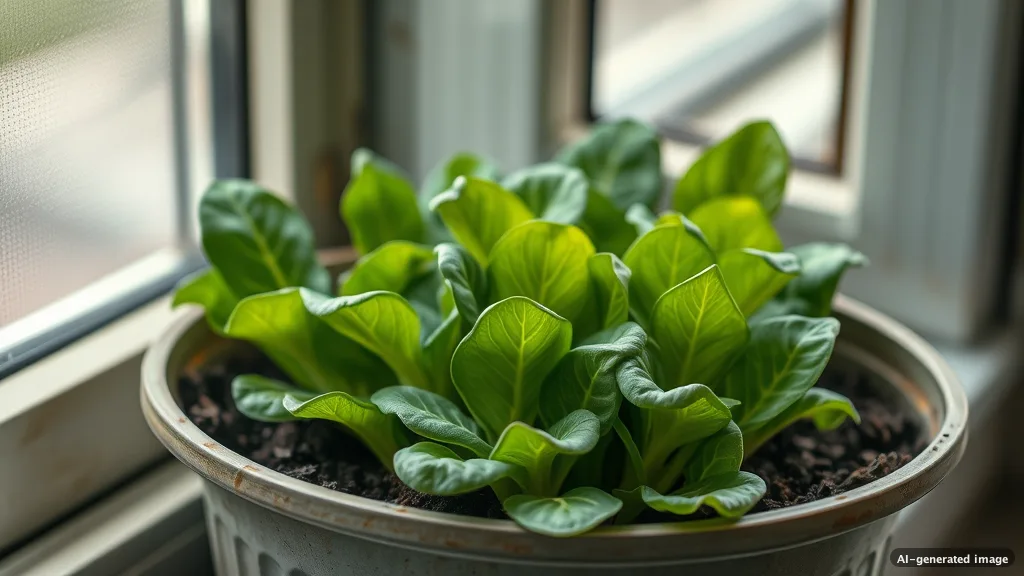
Winter harvest dream through lamb's lettuce pre-cultivation in September
Sow in trays now to enjoy fresh lettuce directly from the bed in the middle of winter.
Sellerina4 min readUpdated on September 22, 2026
Thomas and Sellerina · Completed by the community
In short
Use the window in September and grow your lamb's lettuce in a bowl on the windowsill. If you keep the soil continuously moist for three weeks, you will even have the harvest at your table under a blanket of snow in the middle of winter.
Wintery salad enjoyment
Use the last time window for your lamb's lettuce in September. At the end of September, a window closes in the bed, as it is the last opportunity for this lettuce this year. If you wait week by week, your first bowl of lettuce will be pushed a little deeper into winter.
If you sow now and keep the soil moist for three weeks, you will get fresh lamb's lettuce straight from the bed in the middle of winter. Sown in summer, the lamb's lettuce is on your plate after eight to ten weeks, as it is a real sprinter among leafy vegetables. Sown now in autumn, it suddenly becomes cozy and takes up to sixteen weeks; the later you sow, the further the harvest moves into winter.
At the beginning, there is only one strict rule. The seeds need continuously moist soil for three weeks until they germinate at all. If the soil dries out even once during this time, germination stops and nothing will emerge at all. I ignored that once and harvested absolutely nothing.
That's why pre-cultivation works more reliably. In a tray on the windowsill, it is easier to keep the soil moist for three weeks than outside in the bed, after which you can simply transplant the young plants into the bed. Frost, on the other hand, makes a big fuss and is actually not an opponent at all, because lamb's lettuce is hardy and can even be harvested under a blanket of snow.
The rosette is ready for harvest when six to eight strong green leaves crowd around the center like in an overcrowded subway. The lamb's lettuce has an advantage that no other lettuce possesses: It is the only loner of its own plant family. This is exactly why it fits into every crop rotation and every one of your growing plans as an all-rounder among the successors.
The effort is actually worth it twice over. When you eat it, you benefit from two milligrams of iron per hundred grams, which is unusually high for a leafy vegetable. With thirty-five milligrams of vitamin C, it also has two to three times as much as lettuce, which looks quite pale in comparison.
This is how you get fresh lamb's lettuce from the bed in the middle of winter, if necessary scraped out from under the snow. While your bed outside is still waiting for spring, your lamb's lettuce is already sitting at your table.
Moisture during pre-cultivation
The soil needs constant moisture during the first few days so that your young seedlings do not give up prematurely. When you sow lamb's lettuce, the soil must remain evenly moist throughout the entire germination process. Since its seeds have a very shallow sowing depth of half a centimeter to one centimeter, the top layer of soil dries out as quickly as a sponge in the sun on warm days.
If you do not let the soil dry out during the first three weeks after sowing, you prevent the germination process from stalling. In seedling trays or multi-pot trays, you must always keep the moisture high, but at the same time avoid overwatering. If the soil is too wet, the risk of fungal diseases increases and you invite fungus gnats to lay their eggs in the substrate. The larvae hatching from them can then destroy your roots as if they had a personal plan against your garden.
Good drainage is therefore necessary, which is why well-draining soil is beneficial through the addition of sand or fine gravel. To retain moisture in the soil and simultaneously reduce weeds, you can use a mulch layer of straw or leaves as evaporation protection. Alternatively, moisture can be stabilized with a fleece or perforated film until the seeds have emerged.
Planting time
The right moment for transplanting determines whether your lettuce takes root in the bed or gives up the ghost prematurely. If you use pre-cultivation, you plant your young plants about four weeks after sowing into the soil. You harvest your lettuce in winter or early spring if your sowing period is between August and October. If you only sow in October, the seeds germinate very slowly in the cold soil. An early start rewards you with a harvest from mid-February, provided you place your plants in a cold frame with a window box. You can safely plant the lettuce outdoors without additional protection from mid-March. If you use seedlings from multi-pot trays or propagation containers, you should transplant them about four weeks before the date for being outdoors. The plants stay best in their containers for as long as possible so that removal is successful and clean. You avoid stress for the sensitive root system of lamb's lettuce if you sow it directly, as it reacts poorly to transplanting. If your plants are very weakly developed, repotting is advisable; otherwise, you can often skip this intermediate step.
Identify optimal rosette size
The right time for harvesting depends entirely on the size of your rosette. When you cut the lamb's lettuce with scissors, you should wait for a rosette size of about 10 cm. You will then harvest a juicy result when the leaves are dark green and firm. The plant indicates its maturity as soon as it has six to eight fully developed leaves per rosette. If you only remove the outer leaves, new ones will continuously grow in the center of the plant. You can also harvest the entire plant once it has reached a height of 5 to 7.5 cm. The rosettes reach their full size with 10 to 20 leaves and a diameter of about 8 to 12 cm. If you wait too long, the lettuce will quickly become bitter or tend towards bolting. You usually begin harvesting after six to eight weeks, which corresponds to a period of about 45 to 60 days after sowing. With sowing in September, this waiting time extends to a total of 10 to 12 weeks, as growth progresses more slowly in winter.
Videos open in a new tab at the respective provider. Their privacy policy applies there.
Contributions from garden friends
Garden friends write here from personal experience. Feel free to join in!
1
IKENicknameOctober 12, 2026
We have by now, even here in the Vosges, more than 30° in summer. The sowing of lamb's lettuce is doomed to failure there, as a germination temperature of 10° - 15° is specified for it.
Wir haben inzwischen, selbst hier in den Vogesen, im Sommer mehr als 30°. Da ist die Aussaat von Feldsalat zum Scheitern verurteilt, da für ihn eine Keimtemperatur von 10° - 15° angegeben wird.
1
ThomasGrowSimplyOctober 13, 2026
You are mentioning something that surely we all notice. The climate is constantly changing; the sowing times from ten years ago no longer apply everywhere today.
Therefore, the planting times are calculated based on your local climate. Feel free to use the assistant in the app for this. There, you first adapt your plant selection to your variety and then to your climate (or you do it yourself). Afterwards, you receive the timings that really work for you locally, for example a later autumn window or as pre-cultivation on the windowsill. This way, you always sow when the temperature of your soil is just right.
Du sprichst etwas an, das uns sicher allen auffällt. Das Klima verändert sich stetig, die Saatzeiten von vor zehn Jahren gelten heute nicht mehr überall.
Deshalb werden die Pflanzzeiten anhand deines lokalen Klimas berechnet. Nutze dazu gerne den Assistenten in der App. Dort passt du zunächst deine Pflanzenauswahl an deine Sorte und dann an dein Klima an (oder du machst es selber). Anschließend erhältst du die Zeitpunkte, die bei dir vor Ort wirklich funktionieren, beispielsweise ein späteres Herbstfenster oder als Voranzucht auf der Fensterbank. So säest du immer dann, wenn die Temperatur deiner Erde gerade richtig ist.
Have you had your own experiences with this? Add them — together we make this article better.
You have not set a nickname yet. You can set it in your account.
Do you know about this? Log in to add your knowledge here.
0 / 1500
Review and submit contribution
We read every contribution before it goes public — this sometimes takes a day. After that, it is visible to everyone with your nickname above it.
Report contribution
Please describe in detail what is wrong with this contribution.
Thanks! Your contribution is now under review. As soon as it's approved, you'll receive an email.
Thanks, we'll look into it.
No mental checklists needed — GrowSimply puts the right steps on your to-do list at the right time.
The Vegetable Guide is free — the sowing calendar and the recipes are free to use with an account, too. Behind GrowSimply are many years of development and high running costs. But we deliberately do without advertising. There is no tracking either. If the project helps you, support it now — so it stays this way.
The guide explains the craft. With GrowSimply you can apply it. You get a personal growing plan with suitable time windows for your location (with postcode-accurate weather data), can implement sustainable planning by following crop rotations, and even receive recommendations for good neighbours. So you don't forget anything, you always get to-dos at the right time. GrowSimply wants to be the only app you need – without ads and tracking.
 Sellerina