Good compost needs the right balance of air, moisture and material.
Sellerina6 min readUpdated on September 9, 2026
Thomas and Sellerina · Completed by the community
In short
Composting allows you to close another part of the cycle: harvested plants, prunings and kitchen scraps become new soil for your vegetable growing.
Location and setup
Your compost pile needs a semi-shaded, wind-protected spot in the garden where it can sit directly on the ground. This allows microorganisms and earthworms to easily find their way in to take over decomposition. You should avoid full sun because although heat can speed up rotting, compost does not tolerate direct sunlight. A base layer of coarse material such as twigs, branches, or brushwood ensures good aeration from below. You can build an open pile directly on the ground or use containers made of wire mesh, wood, pallets, concrete blocks, or stone blocks.
A closed system with a thermal composter or rapid composter protects against mice and rats, allowing you to compost other materials as well. When using multiple containers — two to three are ideal — the compost can be passed on step by step. In a dual-chamber model, one is filled while the other decomposes; once one side has fully decomposed, it is emptied.
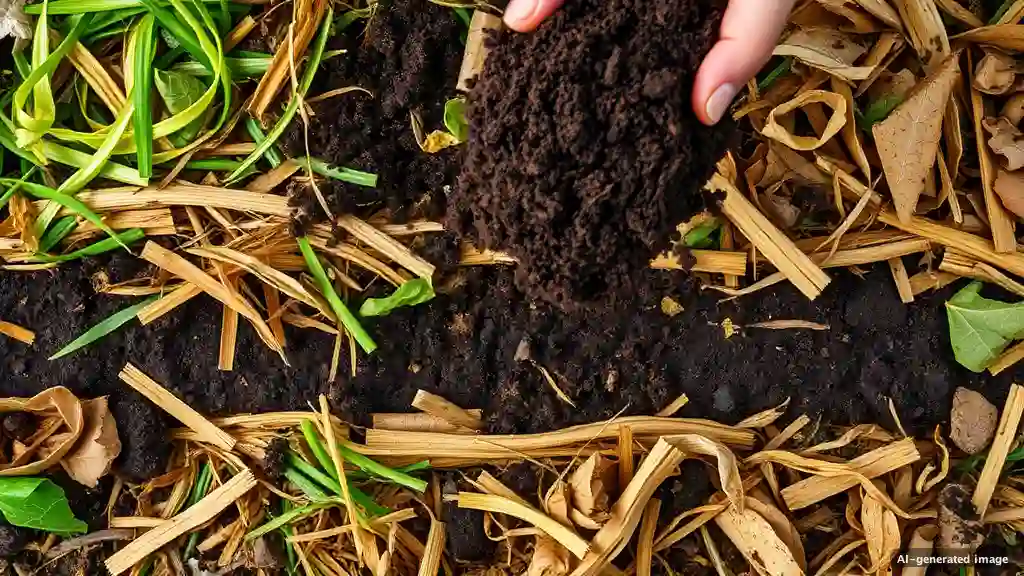
The build should always proceed in layers: green layer of nitrogen-rich materials, brown layers of carbon-rich substances and structural materials like twigs, with soil being scattered between the layers. In rapid composters, materials are piled up in roughly equal thickness and sprinkled with soil. With drying material such as leaves, you mix a layer of old leaves with a layer of fresh grass clippings or other green garden waste. New piles start with a base of coarse material like twigs and branches, over which a thin layer of green material is placed. A pile should have a minimum size of about 90 x 90 x 90 cm.
Materials
Your compost pile lives on a balance between green materials that provide plenty of nitrogen and brown materials that contain carbon. Green components include all types of kitchen waste, grass clippings, plant stems as well as coffee grounds and paper filters. Snails shred kitchen waste faster than worms, which is why they are also welcome in the compost. Brown substances such as dry leaves, straw, twigs, wood chips, unprinted paper, cardboard or sawdust serve as structural materials. For all materials: always build up evenly and, if possible, in layers.
Horn shavings can help specifically manage the ratio with very woody waste. Mature compost, clay minerals, rock flour or zeolite provide additional support; biochar can also be mixed in with a volume fraction of 5 to 10 %. When dealing with leaves, you should note that walnut, chestnut or oak leaves contain particularly many tannins and should therefore remain on top over winter. Manure from your animal garden residents is very suitable for producing rich compost for your heavy feeders. Processing takes a bit longer though; if turning regularly, you can plan for about 12 months.
Regular watering with yeast water — 3 tbsp sugar and 1 tbsp dry yeast per 10 liters of water — helps immensely to speed up the entire process many times over. EM (Effective Microorganisms) can also help accelerate the process.
Special substances
You protect your open compost from visitors you'd rather not have by consistently leaving meat, fish, and bones outside. These scraps attract wildlife such as raccoons, mice, and rats. Dairy products, cheese, fats, oils, or lard are also less suitable for your compost soil.
With plant material, you need to look closely: plants with already developed seeds or root weeds and potatoes that can multiply in the environment which usually does not get hot enough. Sick plants or those infested with pests are also unsuitable because diseases and pests can survive. For citrus fruits, apple, or banana peels, you should ensure they come from organic farming, as the peels are often sprayed. To avoid bringing chemicals and printing inks into the compost, avoid treated or lacquered wood as well as printed paper. Dog or cat feces are not suitable for home composting due to possible disease transmission.
In closed composters, often called quick composters, you can compost many of these materials in balanced amounts with brown and green.
Care and turning
Your compost pile needs air, just like you, so that the tiny helpers inside can keep working diligently. By turning the pile regularly, you bring oxygen where it is needed and prevent the material from being compressed too tightly. Turning also distributes heat so that the hot core does not overheat but instead moves warmth evenly outward. If your pile is too wet, turning helps drain excess water and refill air pockets with fresh air. A well-maintained pile can be ready in three to five months, while an undisturbed pile takes about a year.
With hot composting, a well-maintained pile produces finished compost within just a few weeks depending on the material. A rapid composter shows results fastest. The frequency of turning depends on the shape of your pile, the ratio between green and brown material as well as moisture, microorganisms, and other tiny organisms. With a compost turner you should turn it about 10 to 20 times two to three times per week. An open pile should be turned every 2 to 6 months. The moisture level should be around 50%, with the compost feeling like a wrung-out sponge that you can carefully water if needed.
With hot composting, a new pile heats up quickly and cools down again after only four to seven days. Regular turning at intervals of one to three days helps make the process more even. In any case, you should mix the materials for optimal results.
make your own terra preta, a guide for home.
Compost has a weakness. It breaks down. After two to three years, the humus you painstakingly built up is mostly respired away. Terra Preta solves exactly this problem. Terra Preta means "black earth." The term comes from the Amazon region. There, people created soils centuries ago that are still fertile today. The difference from normal compost is a single additive: biochar.
Biochar is charred wood or green material. It is permeated by millions of tiny pores. A single gram thus provides several hundred square meters of internal surface area. These pores store water and nutrients and offer protection to soil bacteria. Unlike compost, biochar does not decompose. It remains in the soil for centuries.
Mix green waste and kitchen scraps with biochar, rock flour, and clay meal (e.g., bentonite). The clay binds humus to itself and makes the soil a second nutrient reservoir alongside the charcoal. Water each layer with effective microorganisms or yeast water; this recharges the biochar. The other layers remain as before.
Berkeley method heat rot
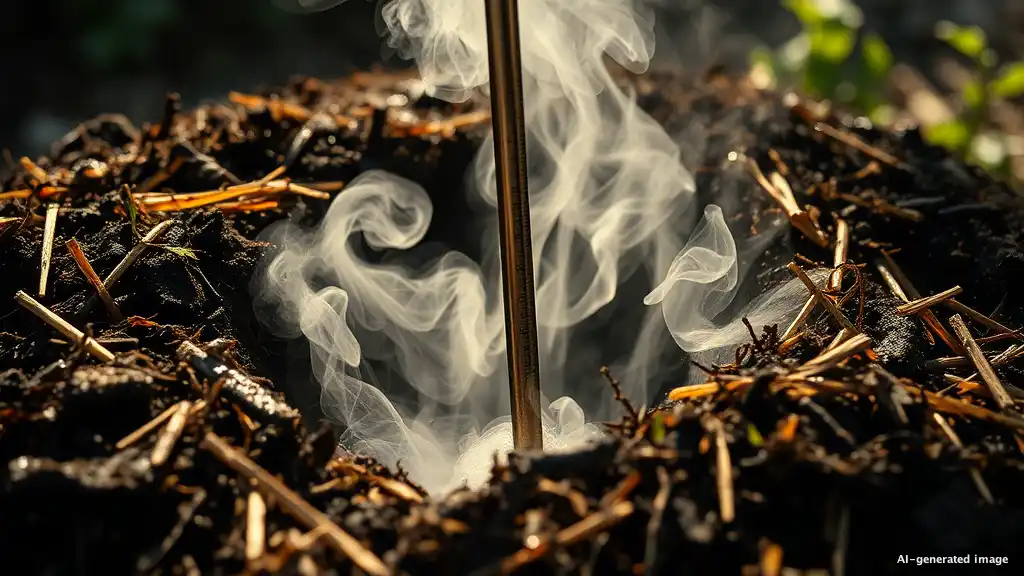
A pile of about 1 m³ (approx. 1 x 1 x 1 meter) in a semi-shaded spot with direct contact to the topsoil forms the basis for rapid hot composting, where weed seeds and pathogens are killed by heat. You layer about three parts brown material like straw, leaves or wood chips (no whole branches or twigs) over one part green material like grass clippings, kitchen waste or manure, to achieve a carbon-to-nitrogen ratio of approximately 25:1 to 30:1. Each layer must be watered intensively so that it feels like a well-wrung sponge (use yeast water or effective microorganisms). For the first five days you leave the pile untouched before turning it regularly by bringing outer material inward and inner material outward to ensure aeration. With a probe thermometer, check the internal heat, which should be between 55 °C and 65 °C.
The goal is to keep the heat below 70 °C; above that you risk killing off useful microorganisms, which can manifest as a white film on the pile. By very regular turning from inside out every 3-7 days, you obtain sterile compost in a very short time. Depending on how hard you work, the process takes about 1 to 3 months before your finished compost can be harvested.
This is how GrowSimply does the work for you
Your soil is the foundation for healthy plants and high yields. You will find a lot of useful knowledge here to make your own compost. Create a to-do list, e.g., "garden maintenance", and create to-dos in the intervals you need for optimal care of your compost.
No mental checklists needed — GrowSimply puts the right steps on your to-do list at the right time.
The Vegetable Guide is free — the sowing calendar and the recipes are free to use with an account, too. Behind GrowSimply are many years of development and high running costs. But we deliberately do without advertising. There is no tracking either. If the project helps you, support it now — so it stays this way.
The guide explains the craft. With GrowSimply you can apply it. You get a personal growing plan with suitable time windows for your location (with postcode-accurate weather data), can implement sustainable planning by following crop rotations, and even receive recommendations for good neighbours. So you don't forget anything, you always get to-dos at the right time. GrowSimply wants to be the only app you need – without ads and tracking.
 Sellerina